

Hello. This is Fintag, here to help solve your company's cash concerns.
If your bank recently contacted you about extending a loan, you may have been surprised at how much rates have risen. This Thursday, October 22, the Bank of Korea's Monetary Policy Committee makes one of its two remaining base rate decisions this year. Whether the result is a hold or a hike, there are numbers your finance team should check in advance.
This article covers the background of this decision, how the base rate actually flows into corporate loan rates, what to check for loans, deposits and foreign currency payments, and how to prepare so you can respond on the day of the decision.
Where rates stand now
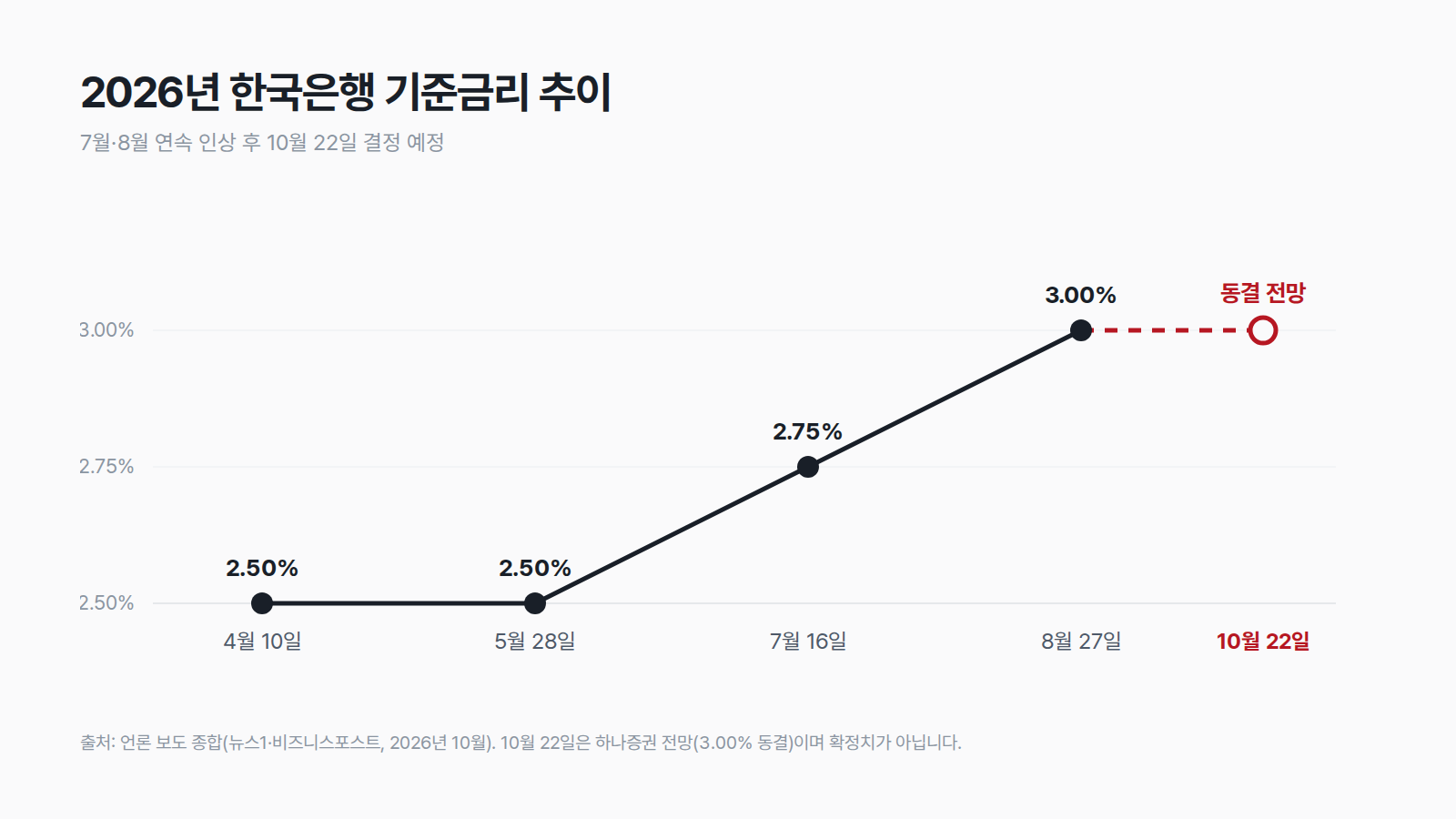
The base rate rose by 0.25 percentage points twice this year, in July and August, and now stands at 3.00% per year. It was the first hike, and the first back-to-back hikes, since January 2023. The backdrop is an economy recovering faster than expected on the back of semiconductor exports, which has increased inflationary pressure.
For the October decision, a hold is the leading view. In an October 16 report, Hana Securities forecast a unanimous hold at 3.00%, and the October financial market briefing from the KDI Economic Information and Education Center also expected a hold, citing the need to assess the effects of the two hikes. At the October 12 parliamentary audit, Governor Hyun Song Shin said the bank had "bought time by raising rates ahead of the US," suggesting it has avoided having to raise rates again in a hurry.
A hold, however, does not mean the hikes are over. Hana Securities described a hold as "a pause in the pace within a hiking cycle," not a signal that the cycle is ending. Governor Shin also expects inflation to stay above 2% for a considerable period, and markets are weighing the possibility of another hike at the November 26 meeting. With the upper bound of the US Federal Reserve's policy rate at 4.00%, the Korea-US rate gap and the exchange rate remain variables.
How the base rate reaches your company's loans
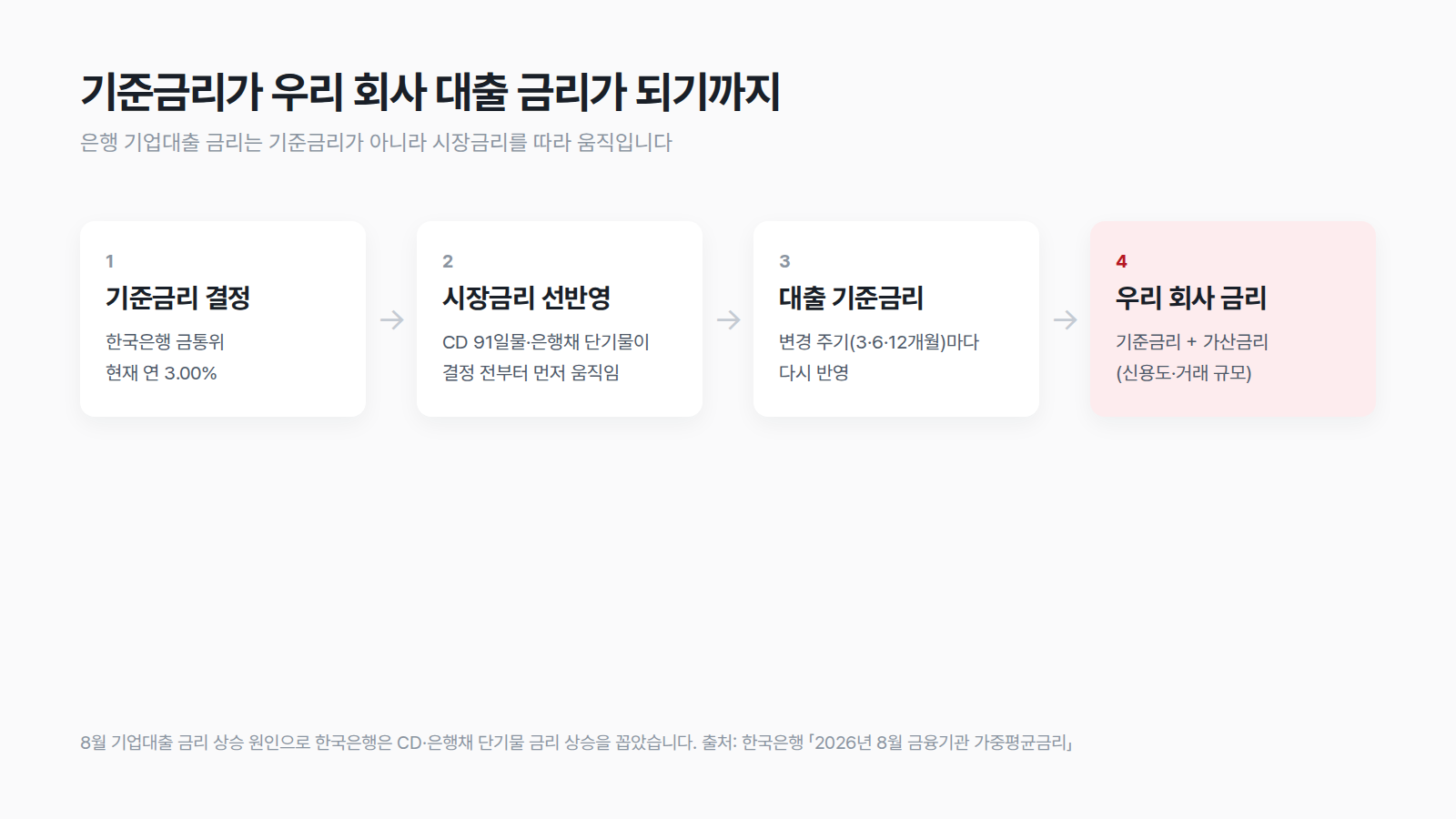
Many people assume that "if the base rate stays the same, loan rates stay the same," but that is not how it works. Banks' corporate loan rates are set not directly on the base rate but on market rates such as the 91-day CD (certificate of deposit) rate and short-term bank bond yields, plus a company-specific spread. Market rates move first, pricing in base rate decisions in advance.
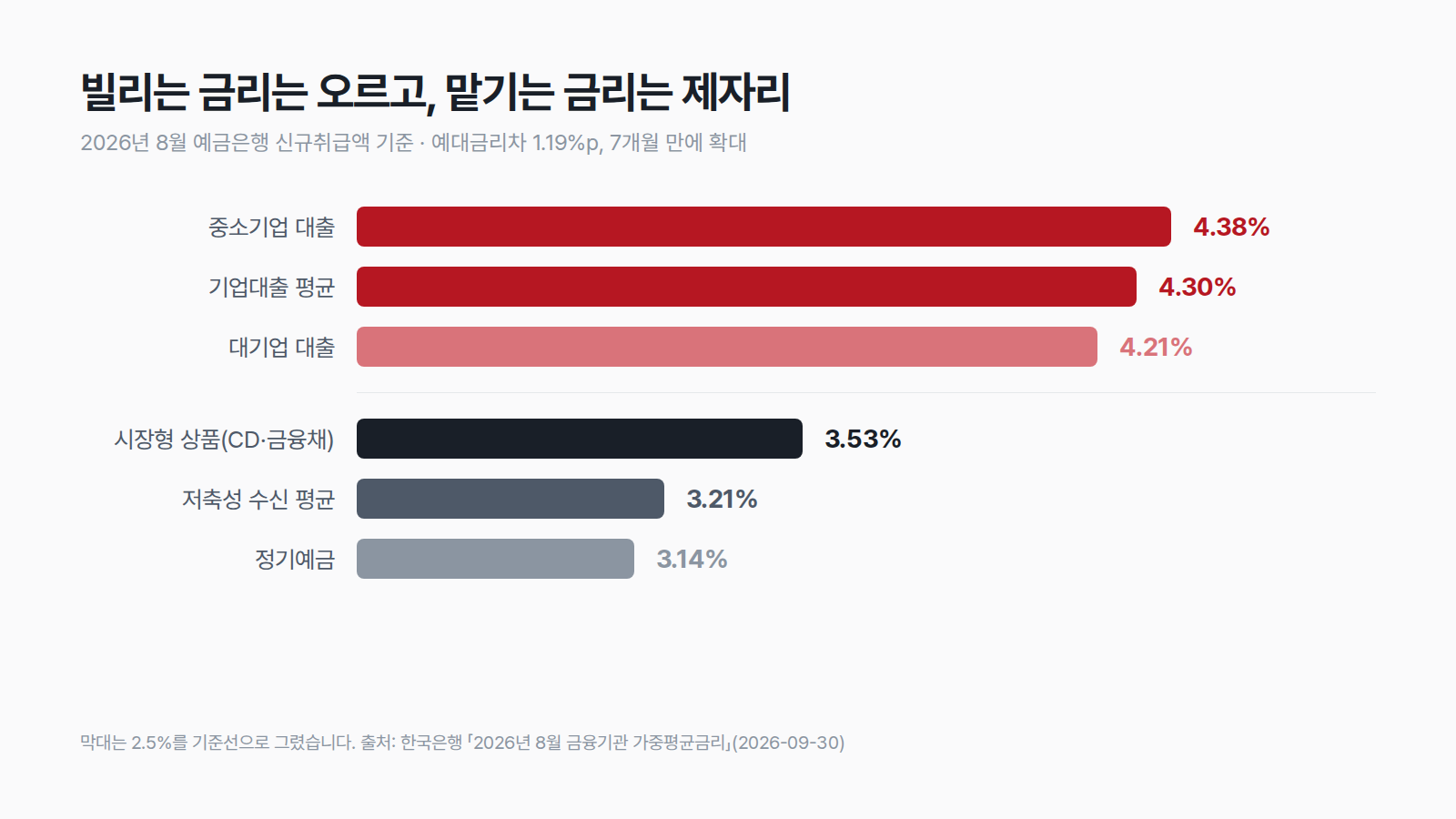
The numbers confirm this. According to August statistics released by the Bank of Korea on September 30, the rate on new corporate loans at deposit banks was 4.30% per year, up 0.10 percentage points in a month. The rate was 4.21% for large companies and 4.38% for SMEs. Over the same period, the 91-day CD rate rose from 2.91% to 2.97% and the three-month bank bond yield from 3.02% to 3.07%, and the Bank of Korea cited this rise in short-term market rates as the reason corporate loan rates went up. It also expected loan rates to keep rising in September as market rates climbed.
Deposit rates, by contrast, stayed put. The August savings deposit rate was unchanged at 3.21%, and the time deposit rate actually fell from 3.16% to 3.14%. As a result, the gap between loan and deposit rates widened again to 1.19 percentage points for the first time in seven months. In other words, this is a period when borrowing rates rise quickly and saving rates rise slowly.
What it means for your loans
When the base rate rises, your company's loan interest does not go up immediately; it rises according to each loan's reset schedule. Floating-rate loans typically re-price to their benchmark market rate every three, six or twelve months, and if market rates have already risen in the meantime, the increase is applied all at once on the next reset date. KDI also expects the three-year government bond yield to edge up from 4.01% at the end of September to around 4.05% at the end of October.
The most accurate way to gauge the added burden is to calculate it yourself.
- Added annual interest = floating-rate loan balance × rate increase — If the rate on a 1 billion won floating-rate loan rises by 0.25 percentage points, annual interest increases by 2.5 million won, or about 210,000 won a month. If market rates have risen 0.5 percentage points since July, the same loan costs 5 million won more a year.
- With several loans, check the months where reset dates cluster — If reset dates fall in the same quarter, interest costs step up all at once from that month. Working capital loans and facility loans often have different reset cycles, so check each loan separately.
- For fixed-rate loans, maturity is the variable — They are unaffected for now, but when you extend or refinance at maturity, you get the rate at that time. Start by listing loans that mature within the first half of next year.
- Check the gap between floating and fixed rates too — Banks explain that more borrowers choose fixed rates when the gap between floating and fixed rates narrows. If you have an extension or new loan coming up, ask your bank how wide the gap between the two is.
Splitting the outlook into two scenarios makes preparation easier. If rates are held in October and again in November, market rates will stay around current levels, so you only need to prepare for the July and August hikes, already priced in, to arrive on your next reset dates. If rates are held in October and raised in November, market rates are likely to start rising before the November meeting. In that case, loans with reset dates clustered around year-end and early next year may absorb two rounds of increases at once, so it is safer to build that added interest into your cash plan in advance.
When negotiating an extension with your bank, it helps to bring your transaction record for the past year and terms from other banks. Spreads depend not only on your company's credit but also on the size of your business with the bank, so having your transactions across several banks organized at a glance gives you grounds for negotiation.

How to think about deposits and spare cash
Rising rates are a burden on the loan side, but they can be an opportunity for spare cash. If a time deposit or installment savings account is nearing maturity, now is the time to compare reinvestment terms. As noted above, however, time deposit rates have not risen as fast as loan rates. In August, market-linked products such as CDs and financial bonds paid 3.53%, higher than time deposits at 3.14%, so remember that rates can differ considerably by product type even within the same bank.
A common question is whether to keep maturities short or long. If further hikes remain possible, shorter maturities let you wait for the next decision; if you think the hikes are ending, locking in today's rate for longer works better. No one can say for certain which is right, so rather than putting all spare cash into one product, splitting maturities into three, six and twelve months leaves room to respond whatever the outcome.
One more thing to consider is the balance with operating cash. Tying up spare cash for longer in pursuit of higher rates, only to run short on a VAT or bonus payment date next quarter and need short-term borrowing, defeats the purpose, because, as we saw, borrowing rates are more than 1 percentage point higher than saving rates. Set aside what will go out over the next three months first, and invest only what remains; that is the basic rule.
Exchange rates and foreign currency payments
If your company pays for imports or overseas services in dollars, keep an eye on the exchange rate as well. KDI expects the won-dollar rate to stay firm-to-steady, moving from 1,357 won at the end of September to around 1,350 won at the end of October. Rising US Treasury yields and foreign selling of Korean stocks weigh on the won, while strong exports and a growing current account surplus support it, so the two forces are offsetting each other.
For companies with large foreign currency payments, calculating the won amount for months with concentrated payments is the most practical preparation. If you have to pay 100,000 dollars next month, every 10 won move in the exchange rate changes your won cost by 1 million won, and a 30 won move by 3 million won. Monthly dollar costs such as cloud and software subscriptions also add up to more than you might expect over a year.
| Item to check | Why it matters | What to do this week |
|---|---|---|
| Floating-rate loan reset dates | Market rate increases apply on the next reset date | List each loan's balance, rate and reset date |
| Loans maturing within 6 months | Extensions get the rate at that time | Organize your transaction record and negotiate terms |
| Deposit maturities | Rates vary widely by product | Plan reinvestment in split maturities |
| FX payment schedule | Even 10 won adds up | Calculate won amounts for heavy payment months |
Responding on the day of the decision
The rate decision is announced on the morning of the 22nd. If you only start digging through each bank's loan records after the announcement, you won't know what changed and by how much until days later. By contrast, a company that has listed its loan balances, rates, reset dates and deposit maturities on a single page can calculate the impact right after the announcement.
The preparation is simple. First, gather loans and deposits from every bank into one list. Next, note each loan's rate type (floating or fixed), next reset date and maturity. Finally, put major outflows over the next three months (taxes, payroll, bonuses, foreign currency payments) on the same calendar. With these three things in place, whether the 22nd brings a hold or a hike, and whatever the November 26 meeting decides, you can calculate the impact on your company in a few minutes.
📌 Before the rate decision, check your company's loans and deposits on one screen. Once you register a certificate or financial institution account, Fintag automatically updates loan and deposit balances, rates, maturities and payment dates from multiple banks on a regular basis and shows them on one screen and a calendar. Try it with a 2-week free trial and organize your company's cash position. → app.fintag.kr
Thank you. Fintag.