

Hello. This is Fintag, where you manage your company's bank accounts, cards and loans in one place.
As the year draws to a close, money tends to sit in the account for a while. If your company collects fourth-quarter revenue first and pays taxes and bonuses after January, several hundred million won may be resting in your checking account right now. This is the season when many finance managers wonder whether to put that money into a time deposit or use it to pay down part of a floating-rate loan.
In this post we use the September rate statistics the Bank of Korea released on October 29 to see how far deposit rates have come, check what each bank is actually paying now, and compare in numbers what happens to KRW 500 million in spare cash when you deposit it versus when you repay. We close with how to split maturities, what is easy to miss with corporate deposits, and the order of things to do this week.
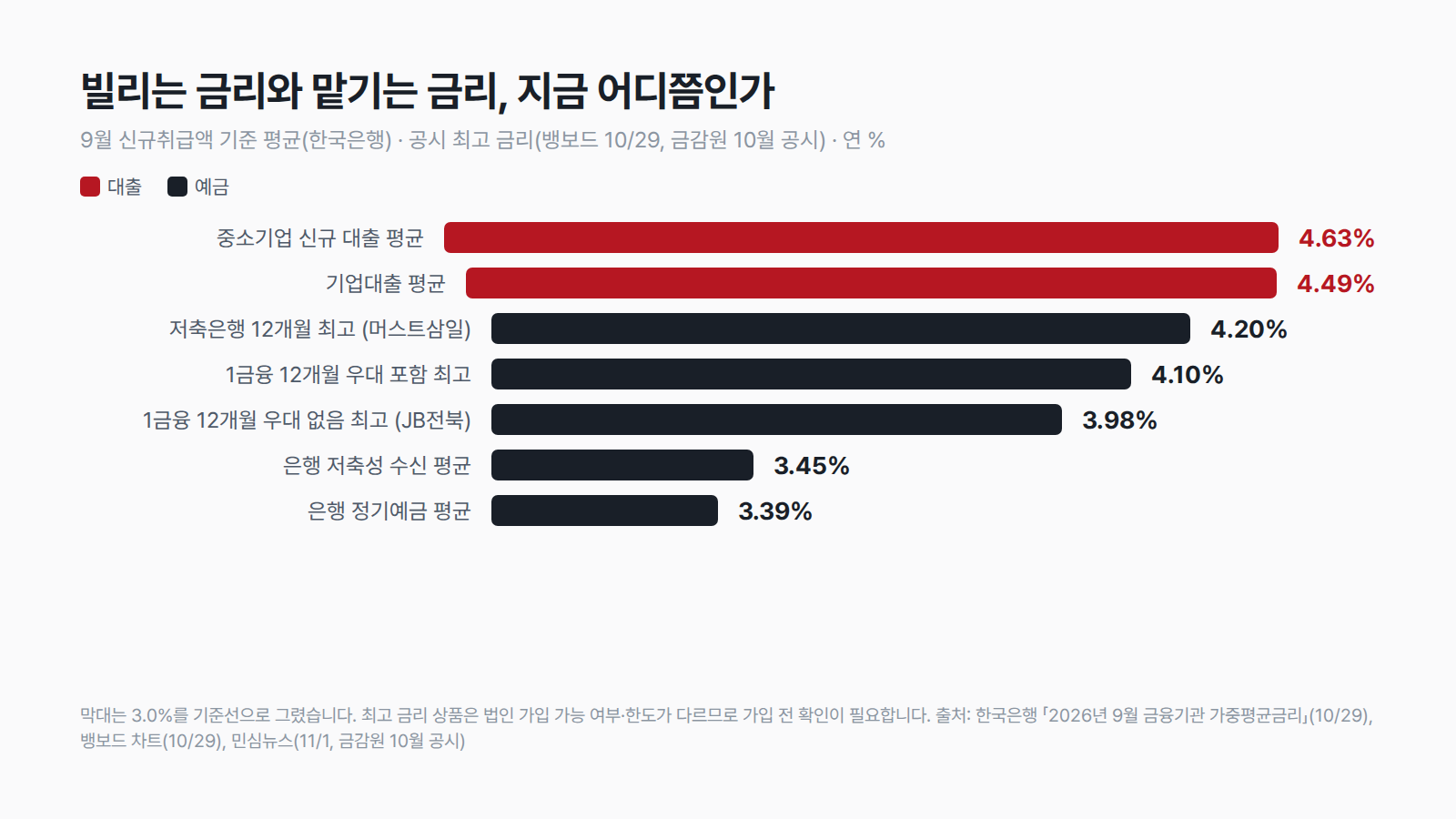
Deposit rates have started to move
According to the Bank of Korea's "Weighted Average Interest Rates of Financial Institutions, September 2026", the average rate on new savings deposits taken by deposit banks in September was 3.45% a year, up 0.24 percentage points in a single month. Pure savings deposits, including time deposits, rose 0.25 percentage points to 3.39%, and market-type products such as certificates of deposit (CDs) and bank debentures rose 0.16 percentage points to 3.69%. Deposit rates that had stood still through August caught up all at once in September.
Loan rates rose in the same month. The rate on new corporate loans rose 0.19 percentage points to 4.49%, and loans to small and medium-sized enterprises (SMEs) rose 0.25 percentage points from 4.38% to 4.63%, a larger increase than for large corporations (4.37%). Kim Sung-jun, head of the Bank of Korea's financial statistics team, explained that the biggest factor was market rates rising by roughly 0.2 percentage points after the August base rate hike. The 91-day CD rate, which serves as a benchmark, rose from 2.97% in August to 3.17% in September, and the 3-month bank debenture rate rose from 3.07% to 3.32%.
Because deposit rates rose more than loan rates, the loan-deposit spread on new business narrowed from 1.19 percentage points to 1.12 percentage points. The distance between the rate you borrow at and the rate you deposit at shrank again for the first time in seven months. Outside the banks, however, the direction differs. For 12-month time deposits, credit unions rose to 3.69% and community credit cooperatives (MG Saemaul Geumgo) to 3.62%, while mutual savings banks fell 0.07 percentage points to 3.81%. Savings banks are gradually withdrawing the high rates they had maintained, and banks are catching up.
Who is paying how much right now
What matters more than the average is the rate on products your company can actually sign up for. In the October 29 tally by the rate-comparison service Bankboard Chart, the highest 12-month time deposit rate among first-tier banks with no preferential conditions was 3.98% a year on JB Jeonbuk Bank's Direct Deposit Account. Suhyup Bank's Hey Time Deposit followed at 3.91%, SC First Bank's e-Green Save Deposit at 3.85%, Kbank at 3.81%, and KakaoBank and Toss Bank at 3.80% each. NH Nonghyup Bank's All-One e-Deposit was at 3.65% and IBK Industrial Bank's Gulligi Account at 3.63%.
If you meet the preferential conditions, BNK Kyongnam Bank's The Deundeun Deposit (Season 2) and JB Jeonbuk Bank's 123 Time Deposit go up to 4.10% for 12 months. Savings banks pay more: by Bankboard's count, Yegaram Savings Bank's rolling time deposit pays 4.13%, and a November 1 article by Minsim News summarizing the Financial Supervisory Service's October disclosures lists Must Samil Savings Bank's e-Time Deposit at 4.20% for both 6 and 12 months.
Two things need checking here. First, a shorter maturity does not necessarily mean a much lower rate. Suhyup Bank's Hey Time Deposit pays 3.91% for 12 months, 3.75% for 6 months and 3.60% for 3 months, so even a 3-month deposit is only 0.31 percentage points below the 12-month rate. By contrast, JB Jeonbuk Bank's Direct Deposit pays 3.98% for 12 months but 2.50% for 3 months, so the rate structure by maturity differs completely from product to product. Second, online-only and individual-only products are mixed in. Whether a corporation can sign up and whether there is a cap varies by bank, so you must confirm before opening.
Deposit or repay: the KRW 500 million calculation
If your company has spare cash and also a floating-rate loan, deciding which is better, depositing or repaying, starts with simple subtraction. The average rate on new SME loans in September was 4.63%, and the highest 6-month time deposit rate at a first-tier bank without preferential conditions was 3.75%. The 0.88 percentage point difference between the two is the starting point for "the money you earn by repaying".
Suppose you put KRW 500 million in spare cash to work for six months.
- If you deposit it in a time deposit — KRW 500 million × 3.75% × 6/12 = about KRW 9.38 million in pre-tax interest. When the interest is paid, 14% corporate tax plus 1.4% local income tax, 15.4% in total, is withheld, so about KRW 7.93 million lands in the account, and the KRW 1.44 million withheld is credited as prepaid tax when you file corporate tax.
- If you repay KRW 500 million of the loan — KRW 500 million × 4.63% × 6/12 = about KRW 11.58 million in interest that no longer goes out. The interest saved is not taxed, but your deductible expenses fall by that amount and taxable income rises, so the after-tax effect must be compared on the same basis as deposit interest.
- Pre-tax difference — KRW 11.58 million − KRW 9.38 million = about KRW 2.2 million. This equals the 0.88 percentage point rate gap × KRW 500 million × 6/12.
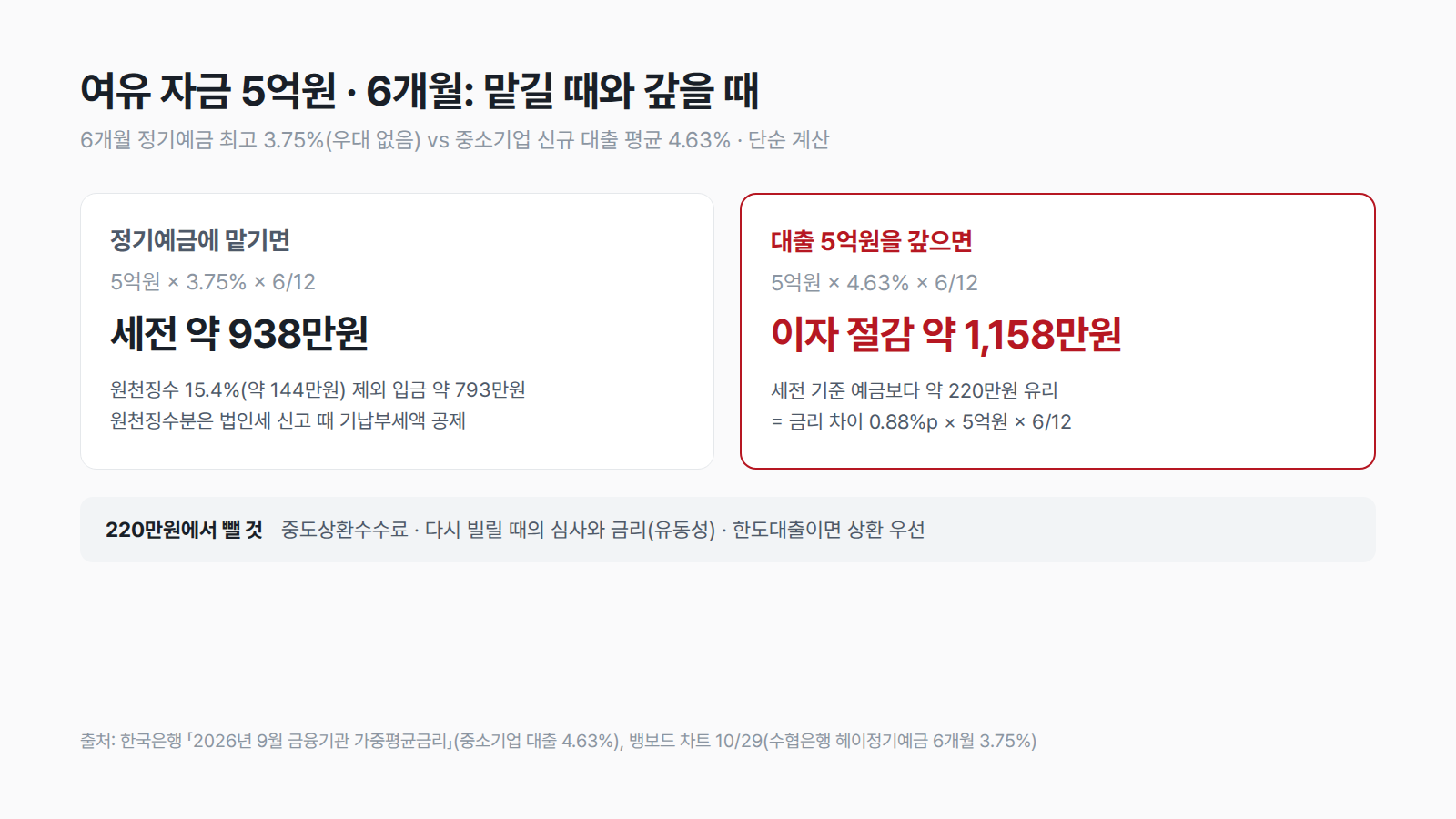
On the numbers alone, repaying is KRW 2.2 million better, but there are two hidden costs. One is the early repayment fee. If your loan agreement still carries an early repayment fee, subtract that amount from the KRW 2.2 million. The other is liquidity. If you repay and then need to borrow again three months later, you go through a fresh credit review and get the rate prevailing at that time. By contrast, a credit line such as an overdraft account can be repaid and drawn again without restriction, so using spare cash to pay down a credit line first is almost always the better choice.
That is why the actual decision is not "deposit everything or repay everything" but a split. Money that will certainly go out within six months (taxes, bonuses, settlements) goes into deposits with maturities matched to the payment dates, and only the amount left beyond that goes to loan repayment. If you have a credit line, repay it first; if it is an installment loan, look at the fee and the likelihood of re-borrowing first.
Split the maturities, and line them up with the next rate meeting
Even the money you decide to deposit is better not put into a single product. The Bank of Korea's base rate has stayed at 3.00% a year since the August hike, and the next Monetary Policy Board meeting is on November 26. Kim Sung-jun noted that while the CD rate rose a further 0.07 percentage points through October 23, the 5-year bank debenture rate fell 0.16 percentage points, and said loan rates could come down if they follow the benchmark rates. Short-term rates are still rising while long-term rates are falling, so betting on either side is risky.
A ladder that splits maturities into 3, 6 and 12 months is what you use at times like this. If you divide KRW 300 million into KRW 100 million across the three maturities, one tranche comes back every three months, and you roll it into a new 12-month deposit at the rate of the day. If rates rise further, the returning money earns the higher rate first; if they fall, the money locked in for longer keeps the earlier rate. With a product like Suhyup Bank's Hey Time Deposit, where the 3-month rate is only 0.31 percentage points below the 12-month rate, the cost of splitting short is small too.
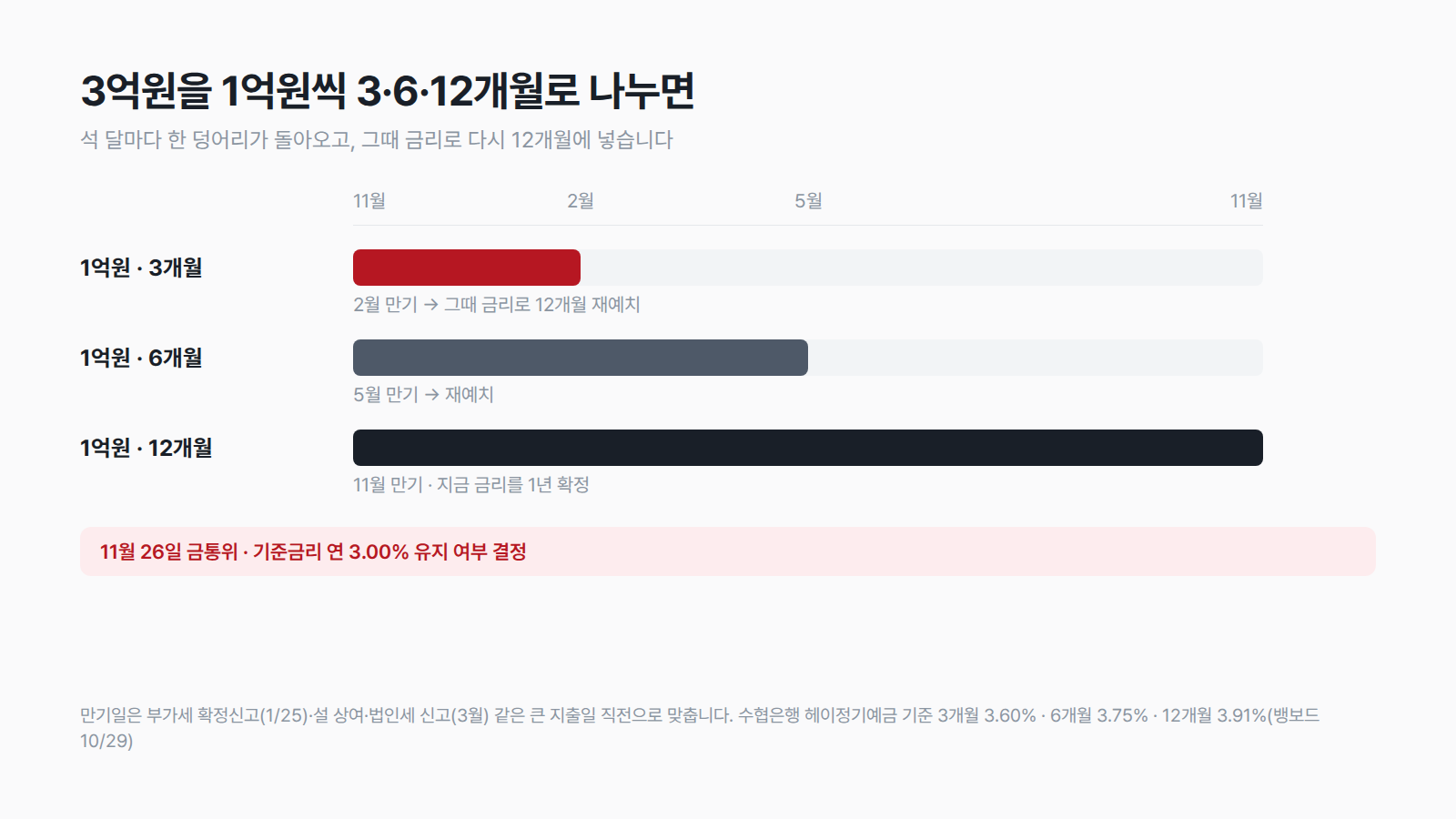
When setting maturity dates, match them to just before your company's big payment days. Put the large-amount dates on the calendar first, such as the January 25 value-added tax final return, Lunar New Year bonuses and the March corporate tax return, and open deposits so they mature a few days before, and you can take the money out without an early termination.
What is easy to miss with corporate deposits
Corporate deposits differ from personal deposits in a few points that need separate attention.
- Withholding and prepaid tax — 15.4% is withheld from interest a corporation receives. This is not tax that disappears but a prepayment credited against the computed tax when you file corporate tax. If you do not keep the withholding tax receipts, the credit is easy to miss.
- Early termination rate — If you break a deposit before maturity, the early termination rate applies instead of the contracted rate. Matching maturities to payment dates is the surest safeguard.
- Deposit insurance limit — Per financial institution, corporations are also protected up to KRW 100 million including principal and interest. When you place well over KRW 100 million at one institution, look at its soundness as well.
- Eligibility and caps — Online-only products are sometimes closed to corporations or carry low caps. After reviewing disclosed rates, confirm the rate you can actually get at the corporate counter or in corporate internet banking.
- Realism of preferential conditions — Conditions such as salary transfers and card spending are often hard for a corporation to meet. Comparing on the base rate without preferences is the safe approach.

What to do this week, in order
There are four steps. First, gather every bank's checking balances, time deposits and loans into a single list. Next, write down the large payments due over the next six months by date and amount, and calculate the "money you can lock up". Third, check the rates on floating-rate loans and credit lines and whether early repayment fees apply, and set the amount to repay. Finally, split what remains into 3, 6 and 12 months and open deposits that mature just before the payment dates.
| Check item | Number to look at | Decision rule |
|---|---|---|
| Money you can lock up | Balance − payments within 6 months | Only this amount is deposited or repaid |
| Whether to repay | Loan rate − deposit rate | Repay if gap × amount × period > fee |
| Credit line | Drawn balance | Repay first with spare cash |
| Deposit maturity | Next big payment date | Mature just before it, split 3·6·12 months |
| Corporate eligibility | Product terms | Check online-only or individual-only |
Of these four steps, the one that takes longest is the first: pulling scattered accounts and loans into a single list. With more than three banks, you have to re-check balances, rates and maturities every time, and meanwhile the spare cash in your checking account sits earning nothing. A company that sees balances, loans and maturities on one screen can recalculate "deposit or repay" in a few minutes every month.
📌 Before deciding whether to deposit or repay your spare cash, check every bank's balances and loans on a single screen. Once you register a public certificate or financial institution account, Fintag periodically and automatically updates deposit and loan balances, rates and maturity dates across multiple banks and shows them on one screen and a calendar. Try the 2-week free trial and sort out your company's cash position yourself. → app.fintag.kr
Thank you. From Fintag.