
Hello. This is Fintag, where you manage your company's bank accounts, cards and loans in one place.
When you sent financial statements and transaction records to the bank ahead of a loan renewal, you probably used to picture a staff member turning the pages one by one. That process is changing. At banks and capital firms today, it is increasingly common for AI to read the documents first and prepare the company analysis and a draft opinion.
That does not mean there is now a secret to impressing AI. But whether AI or a person is reading, this has become an environment where whether the numbers agree across documents is the first thing to surface. This post looks at recent cases in the financial sector and how the technology works, then walks through how to reconcile (match up against each other) your company's sales and purchase records before submission, with a worked example.
What is happening in the financial sector
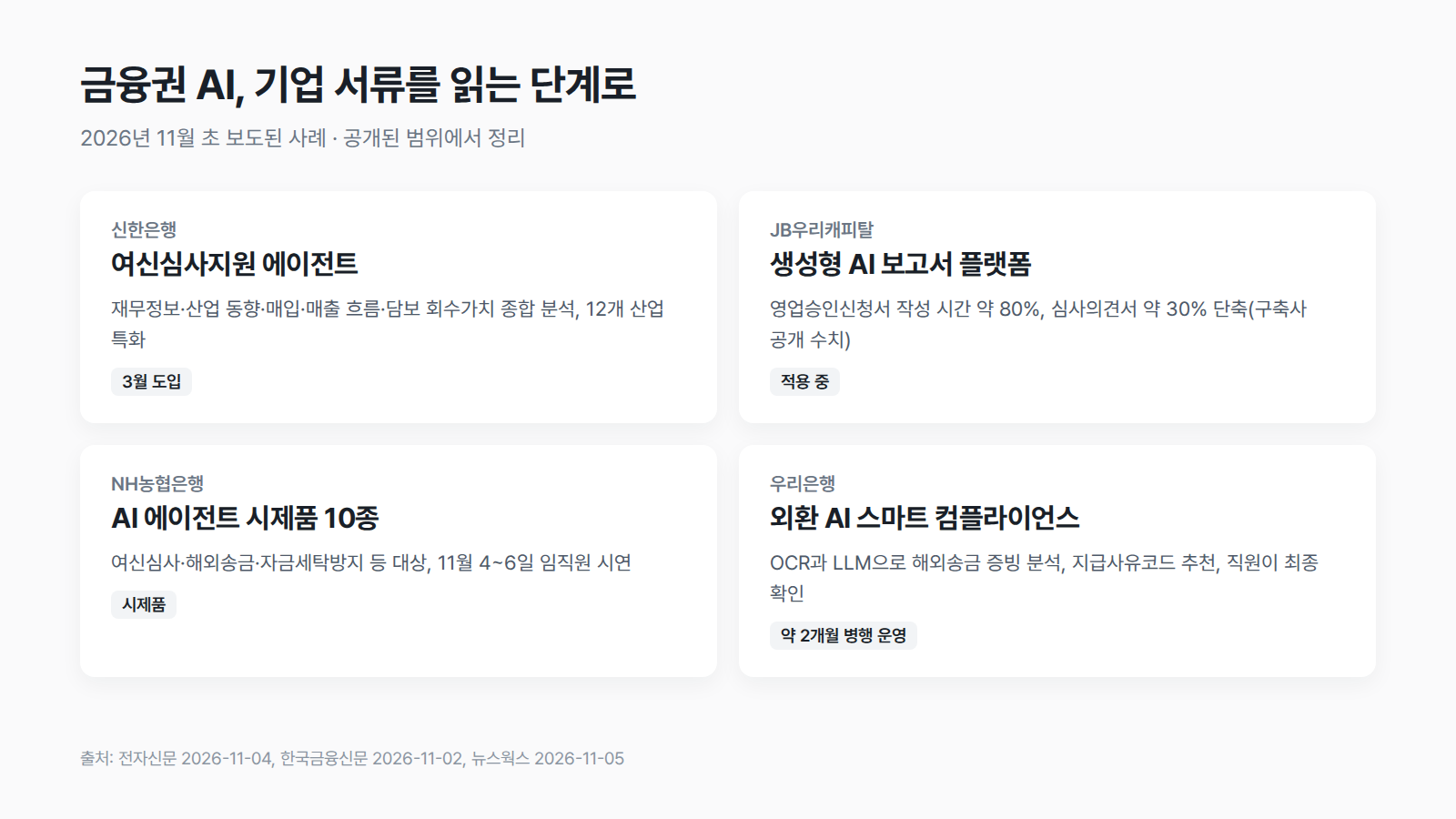
The cases reported earlier this month alone cover quite a broad range. The Electronic Times reported that the "credit review support agent" Shinhan Bank introduced this past March analyzes a company's financial information, industry trends, sales and purchase flows and the recovery value of collateral together. It also has analysis functions tailored to 12 major industries, including manufacturing and software development, and it focuses on easing the burden on staff who analyze companies and write credit opinions.
According to the Korea Financial Newspaper, JB Woori Capital has built a generative AI platform that helps with company information analysis and report writing. The vendor that built it, Megazone Cloud, says the time spent writing business approval requests fell by about 80% and the time spent writing review opinions fell by about 30%. These figures describe document writing time, not review outcomes, and they were published by the vendor, so keep that in mind.
NH NongHyup Bank, together with AgileSoDA, the AI company it acquired this past July, built 10 prototype AI agents for areas such as credit review, overseas remittance and anti-money laundering, and demonstrated them to employees on the 4th through the 6th. They are still at the prototype stage. Woori Bank has introduced "Foreign Exchange AI Smart Compliance," in which AI analyzes the supporting documents for corporate customers' overseas remittances, and it plans to apply the system fully after running it alongside the existing method for about two months to confirm its safety.
Behind this rush to invest is the expansion of corporate banking. At the end of March this year, corporate loans made up 55.7% of Shinhan Bank's won-denominated loans, above the 52.0% average of the four major commercial banks at the end of last year. The work of banks is shifting toward processing more corporate loan documents, faster.
How AI reads documents
The Woori Bank case discloses the mechanics in comparatively good detail. First, OCR (optical character recognition, a technology that turns characters in an image into text) extracts the characters from the supporting documents. Next, an LLM (large language model, an AI that interprets the meaning of sentences) analyzes the document's content and the purpose of the remittance, recommends a suitable payment reason code and enters the extracted information into the system. A staff member then checks the result and processes the work.
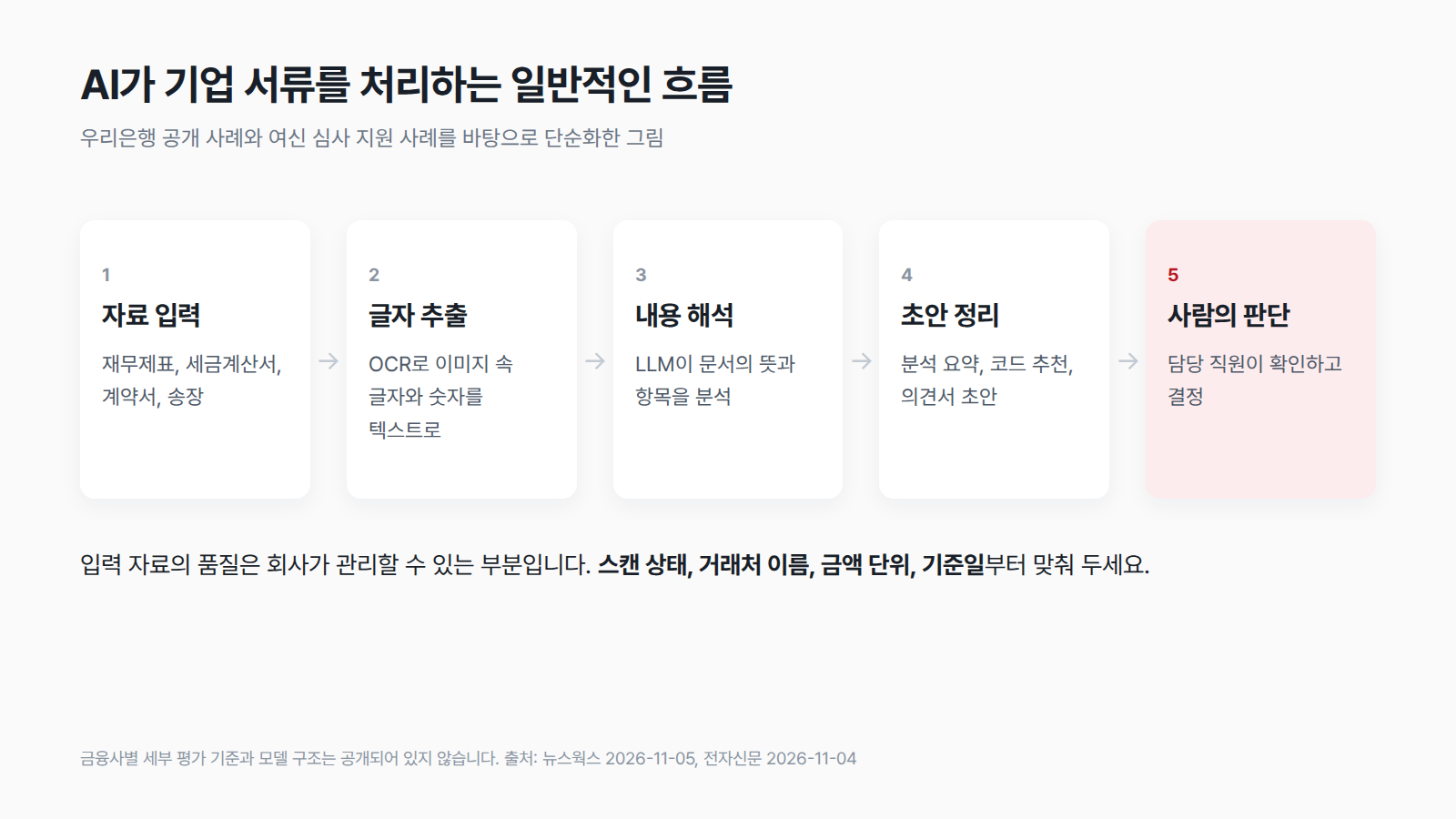
Credit review support is easiest to understand as a similar structure. It pulls numbers from tables with a set format, such as financial statements, summarizes the meaning of written material, such as business plans, and places these alongside industry information to produce a draft. However, each financial firm's detailed evaluation criteria and model structure are not public. You should treat any explanation that claims to know which numbers are weighted how heavily with suspicion.
In this structure, the part your company should care about is the input side. A skewed scan or a blurred seal mark can lead to character recognition errors, and if the same supplier appears under different names across documents, it may not be grouped as one company. The same goes for mixing a table in millions of won with a table in won. Differences a person would notice may be processed by a machine exactly as they are.
Will AI make the decision?
In the published cases, the final judgment remains with people. Shinhan Bank's agent is described, as its name suggests, as a tool that "supports" review, and at Woori Bank, too, staff make the final check. The model JB Financial is considering also leans toward organizing consultation information and financial records and supporting review judgments. For now, it is more accurate to think "a person made a judgment after seeing materials organized by AI" than "AI rejected the loan."
What changes for your company is the order of explanation. If staff receive a draft first, discrepancies between documents can become noticeable items before the meeting even takes place. What you could once explain in person by saying "that was a one-off expense" is now safer to write into the materials in advance.
The overall corporate lending environment also needs to be considered. The delinquency rate on small and medium-sized business loans at the five major banks stood at 0.60% at the end of the third quarter, the highest in nine and a half years. This is a period when banks have more reason to look closely at sales and purchase flows.
A worked example of sales and purchase reconciliation
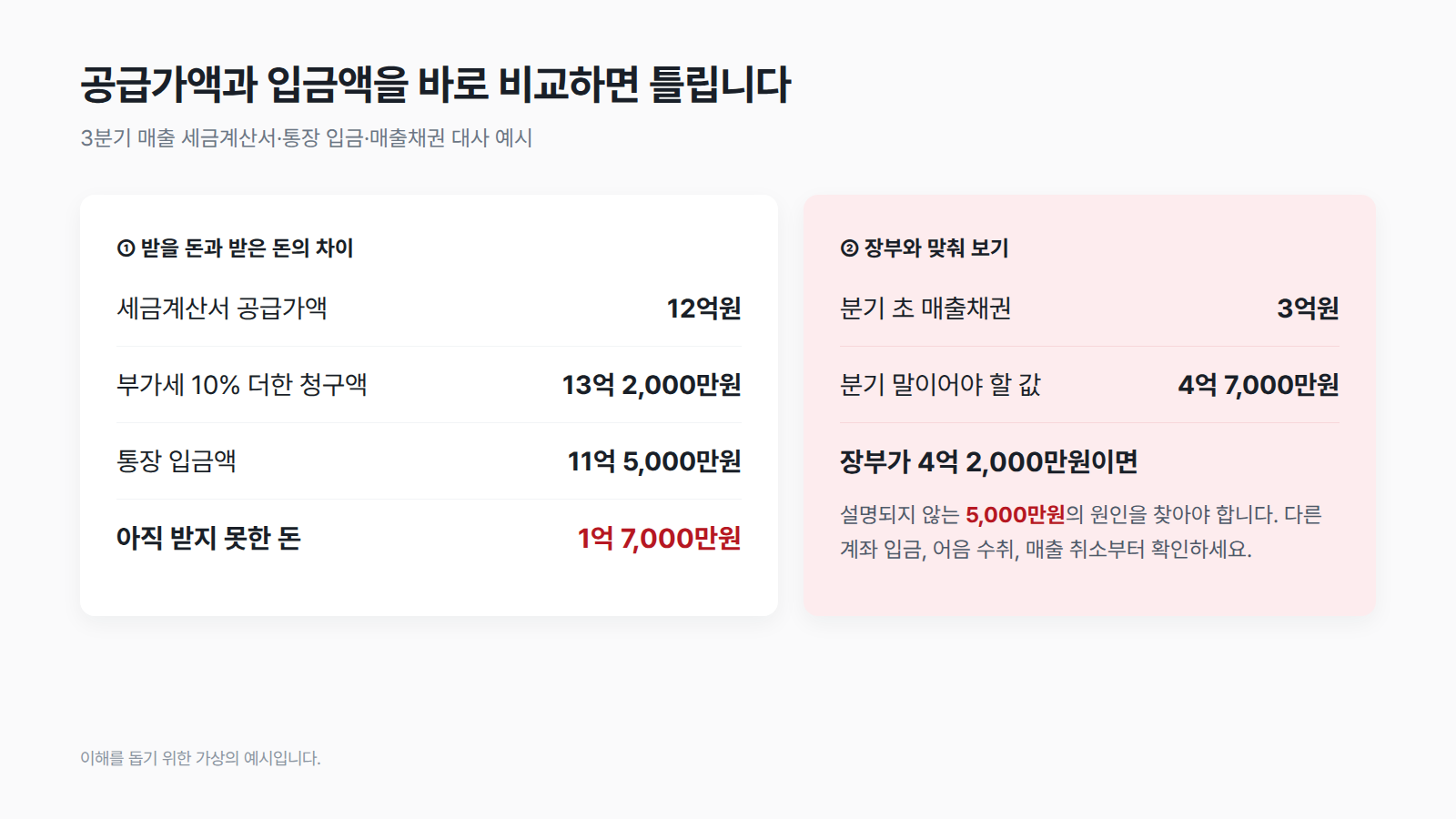
Reconciliation is the work of checking whether tax invoices, bank deposits and ledger balances agree with one another. Take one company's third-quarter records as an example. The supply value of the sales tax invoices it issued in the third quarter is KRW 1.2 billion.
This is where the most common mistake appears. The supply value on a tax invoice excludes VAT, while the amount deposited in the bank account includes it. Adding 10% VAT brings the billed amount to KRW 1.32 billion. If bank deposits for the same period are KRW 1.15 billion, the difference you need to compare is not KRW 50 million but KRW 170 million.
That KRW 170 million should be money not yet received. If trade receivables at the start of the quarter were KRW 300 million, trade receivables at the end of the quarter should be KRW 470 million. If the ledger balance is exactly KRW 470 million, the records reconcile. If the ledger shows KRW 420 million, KRW 50 million remains unexplained, so you need to look for causes such as deposits to another account, notes received or canceled sales.
Purchases work the same way. Subtract bank and card payments from the VAT-inclusive total of purchase tax invoices to get the increase in trade payables. If this figure differs from the ledger, payments made in cash or from another account have likely been left out.
One more number to check is customer concentration. If deposits from one customer exceed half of the third quarter's sales deposits, it is an item that any AI tool would readily spot. It is not something to hide but something to explain up front, along with the contract period and payment terms.
Four steps to reconcile before submission
Before sending documents, run through them once in the order below. Repeat it every quarter and it becomes a job that takes under an hour.
- Gather the originals — Put the tax invoice totals, deposit and withdrawal records for every account, corporate card records and the trial balances for the previous and current quarters in one folder. If an account is missing, you will not be able to find the cause of a reconciliation difference.
- Align the amount basis — Standardize on one basis for VAT inclusion or exclusion, won or millions of won, and the reference date. Write the unit and reference date at the top of each table.
- Calculate the differences and find the causes — As in the example above, work out the differences for sales and purchases and match them to changes in the ledger. Write down causes starting with the largest amounts rather than chasing small differences.
- Attach explanatory notes — Write one line each for items likely to draw questions, such as one-off expenses, major customer changes and temporary receipts from the CEO. Attach them to the first page of the materials so that people and AI alike read them first.
| Item to check | Common problem | What to do in advance |
|---|---|---|
| Scan quality | Skew, blurred characters, overlapping seals | Prefer original PDFs; scan documents upright |
| Supplier names | Different abbreviations across documents | Standardize by business registration number |
| Amount units | Mixed won and millions of won, VAT inclusion or exclusion | Label the unit and basis on each table |
| Reference date | Month-end, issue and deposit dates are mixed | State the reference date in the table title |
| One-off items | A large expense appears with no explanation | Add a one-line note with the amount and reason |
Because this work involves sensitive materials, you should also review the scope of sharing. The originals used for reconciliation contain account numbers and personal information, so leave only the items the bank has requested in any file you send outside. Before uploading originals to a general-purpose AI service to have it do the reconciliation, it is advisable to first check that service's data handling standards.
Having the numbers in one place makes it faster
The most time-consuming part of reconciliation is not the calculation but gathering the materials. With three banks and two corporate card companies, you have to download transaction files five times, and the periods and item names all differ. When deposit and spending records are gathered in one place, you can spend your time on finding causes.
If your next loan renewal or new application is three months or more away, we recommend practicing once with this quarter's records. If you find the items that do not match first, you can give a better-prepared explanation in the meeting, whether or not the bank uses AI.

📌 Before sending your loan documents, match your company's deposits and spending in one place. Once you register a public certificate or financial institution account, Fintag periodically and automatically updates and gathers transaction records from multiple bank accounts and cards, and its AI chat, based on your company's data, helps you find the records you need and even draft documents. Start right away on the free plan. → app.fintag.kr
Thank you. From Fintag.