
Hello. This is Fintag, the cash management partner for small and mid-sized businesses.
Landing a big order is good news, but owners who run a factory think about the next calculation first. Materials have to be bought now, production takes two months, and payment arrives long after delivery. The industry often calls this stretch, where the bank account gets tighter as orders grow, the threshold of "bankruptcy despite profits."
The announcement the government made on November 12 targets exactly this stretch. At the 4th Public-Private Joint Review Meeting on Mega-Projects, held at Samsung Electronics' Onyang Campus in Asan, South Chungcheong Province, the Ministry of SMEs and Startups presented its "Plan to Strengthen the Role of SMEs in Spreading Mega-Project Results." Below we summarize what was announced and which numbers suppliers should calculate in advance.
What was announced
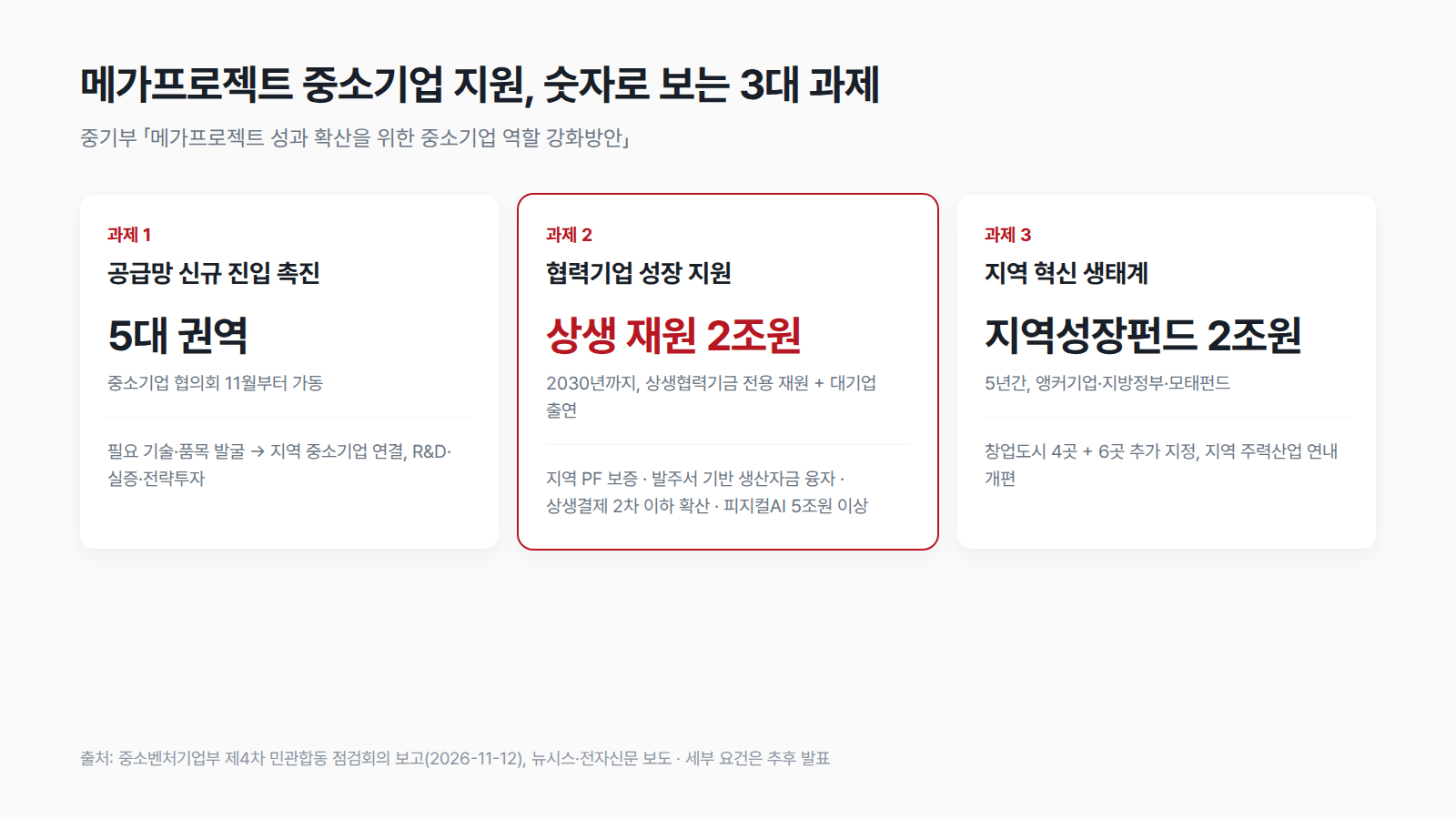
Mega-projects are programs to foster advanced industries and infrastructure through large-scale private and public investment, centered on semiconductors, AI data centers and physical AI. This plan is built around three tasks so that the investment does not stop at large corporations but reaches SMEs as well: promoting new entry into supply chains, supporting the growth of partner companies, and building regional innovation ecosystems.
- SME councils in five regions — Launching this month. When SMEs involved in mega-projects pass on their participation needs and on-site difficulties, the ministry connects them with large and mid-sized companies and with central and local governments to support joint projects and regulatory improvements.
- KRW 2 trillion win-win fund — A dedicated fund will be newly created within the Win-Win Cooperation Fund and, with contributions from large companies and others, built up by 2030. It will be used for technology cooperation to localize supply chains, new facility investment and stronger manufacturing capabilities.
- KRW 2 trillion regional growth fund — Anchor companies, local governments and the Korea Fund of Funds will build it together over five years to invest in related startups and venture companies.
- KRW 5 trillion or more for physical AI — Under the "Strategy for Spreading Physical AI in Small Manufacturers" announced last month, the digital and AI transformation of small manufacturers will be supported through 2030.
The venue was symbolic as well. On the same day, Samsung Electronics' Onyang Campus held a groundbreaking ceremony for a high-bandwidth memory (HBM) production facility, the first step of its investment plan for the Chungcheong region. While facilities of this scale are built and operated, countless orders for equipment, parts, materials and maintenance flow down to suppliers. This plan is closer to a blueprint for making sure the SMEs receiving those orders do not lose work for lack of cash.
Four startup cities are currently being developed, and six more will be designated. Regional flagship industries will also be reorganized within the year. Minister Lee So-young said, "We need to open the door to supply chains for more SMEs and resolve the structural polarization between large companies and their SME partners."
From facilities to payment, cash gaps appear four times
The part finance managers should watch most closely is that financial support is designed by stage: facility investment → order → production → payment receipt. This amounts to acknowledging that a supplier's cash gap does not occur at a single point, but takes a different shape at each stage.
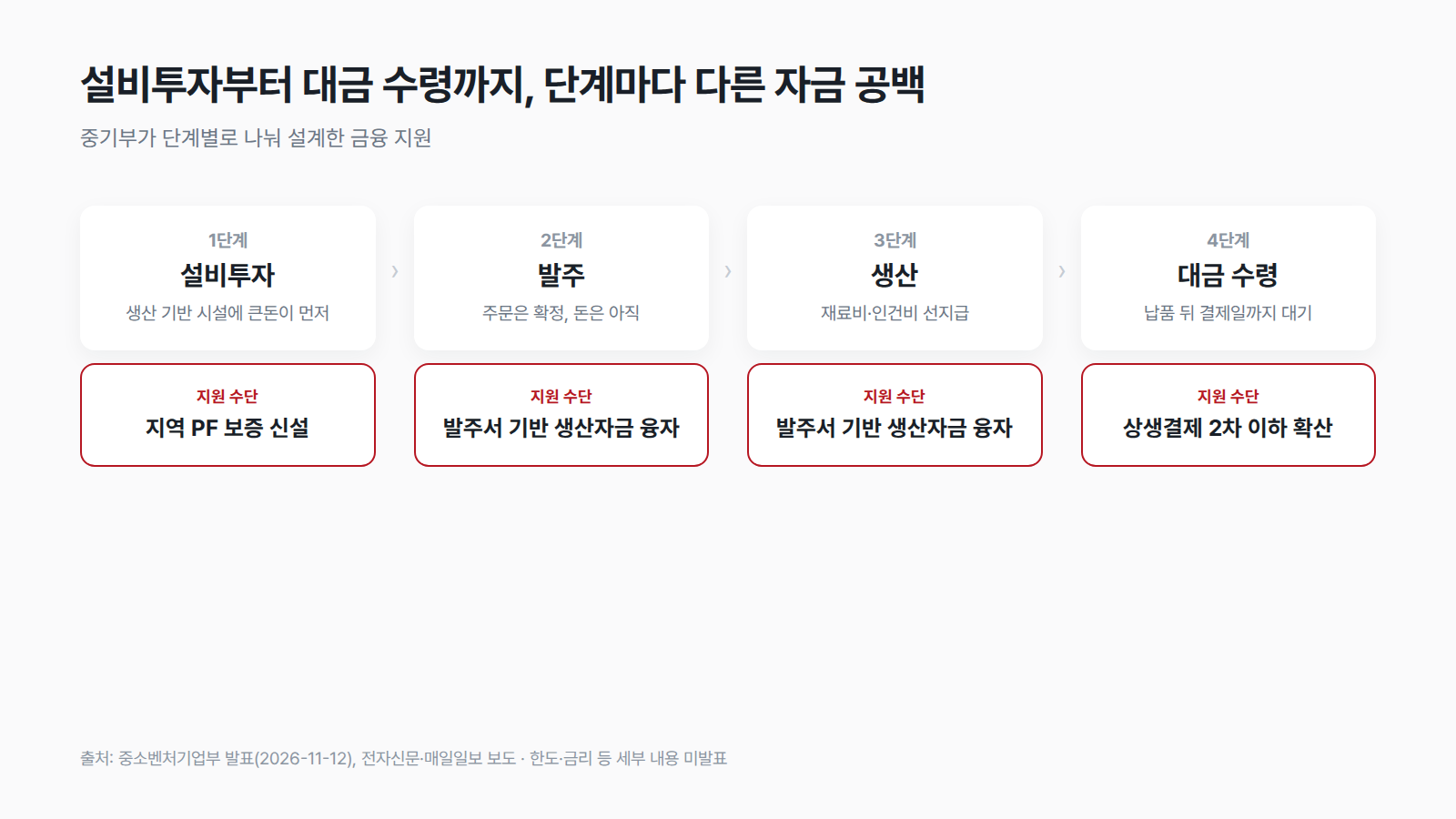
- Facility investment stage — This is the large sum needed to build production facilities. To cover it, a new regional project financing (PF) guarantee will be introduced. PF is a way of borrowing based on the cash the specific project will generate, rather than on the creditworthiness of the whole company.
- Order and production stage — This is the stretch where the order is in hand but materials and labor must be paid first. Loans that provide production funds based on purchase orders will be supported. It means that even a company short on collateral or sales history gets a way to raise funds if it has a confirmed order.
- Payment receipt stage — This is the wait for payment after delivery. The win-win payment system will be extended to second-tier and lower suppliers. Under this system, the payment terms set at the top carry through unchanged to suppliers below, so second- and third-tier suppliers can also be paid on time or convert receivables to cash early at a low cost.
That said, this announcement is a plan that sets a direction. Details such as the limits and interest rates of purchase-order-based loans, how the win-win payment system will be expanded, and the eligibility requirements for PF guarantees have not been released yet. What to do now is not to fill out an application, but to get your company's numbers ready.
Calculate your company's cash gap
Let us look at an example of the hole a single order makes in a company's account. Suppose a second-tier supplier that makes parts for semiconductor equipment receives a KRW 500 million order.
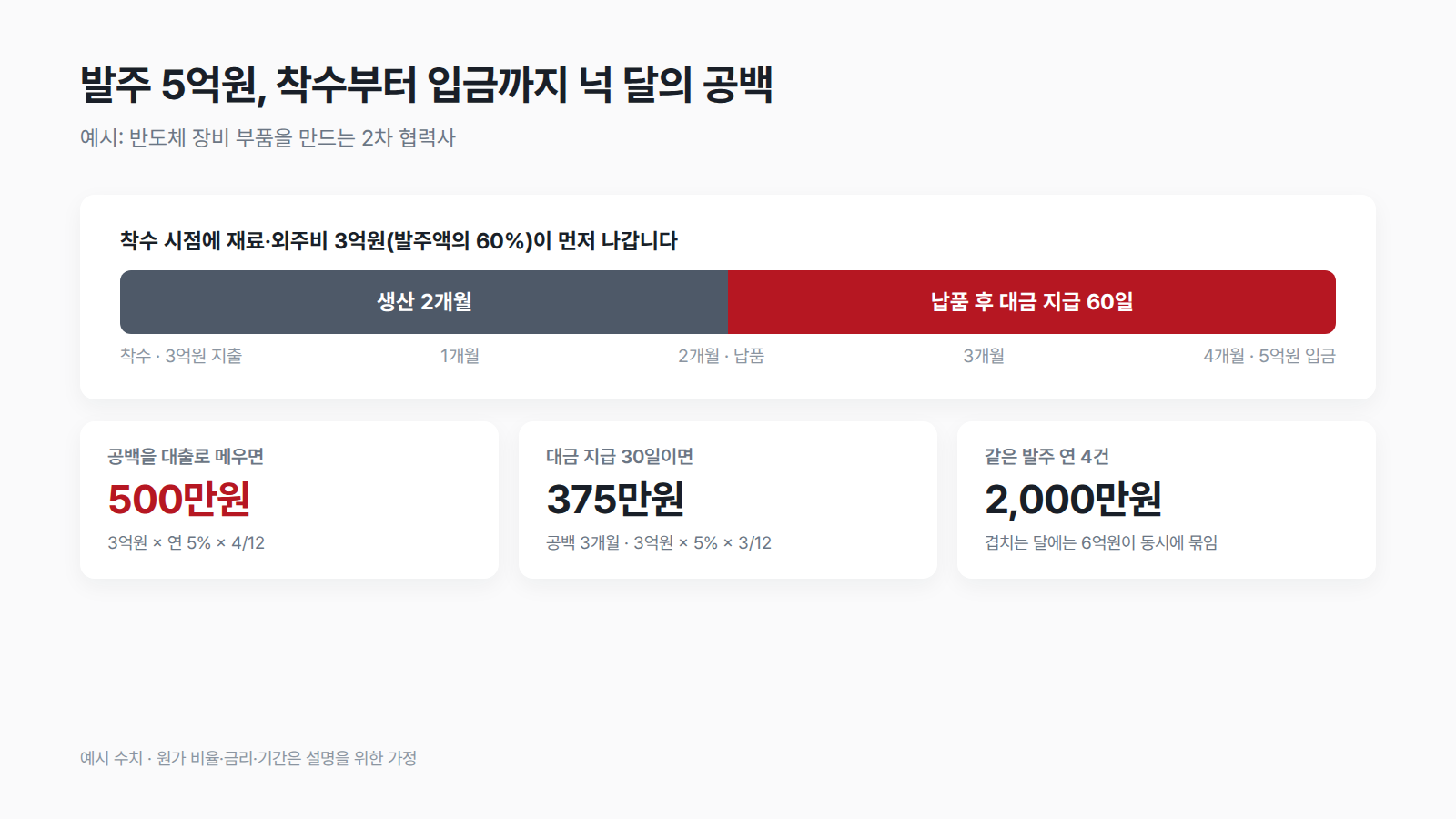
- Money that goes out first — If materials and outsourced processing cost 60% of the order value, KRW 300 million must be paid when production starts.
- The waiting period — If production takes two months and payment arrives 60 days after delivery, it is about four months from production start to payment.
- Filling the gap with a loan — Assuming KRW 300 million is borrowed for four months on a short-term loan at 5% a year, the interest is KRW 300 million × 5% × 4/12 = KRW 5 million.
If the same company receives four such orders a year, interest alone comes to KRW 20 million, and in months when orders overlap, KRW 600 million can be tied up at once. If fixed expenses such as payroll and VAT fall in the same month, the company can end up in a situation where the more orders it wins, the closer its balance gets to zero. The ratios and interest rate above are assumptions for illustration; an actual calculation must use your company's cost structure and trading terms.
Once purchase-order-based loans actually open, the third line of this example changes. If funds can be raised at production start on the basis of a confirmed purchase order, companies that used to give up orders for lack of collateral can take the work. If the win-win payment system reaches second-tier suppliers, the "waiting period" in the second line can be shortened or its cost reduced.
Doing the math reveals one more thing. For the same KRW 500 million order, if payment terms change from 60 days to 30 days, the gap shrinks from four months to three and interest falls from KRW 5 million to KRW 3.75 million. Even while waiting for support programs, you can reduce the size of the gap simply by negotiating payment terms with your customers or by buying materials in installments matched to the production schedule.
Where does your company fit?
The ministry sees that companies trying to enter a supply chain for the first time and those already in a partnership have different needs, and it has split its support accordingly.
- Companies seeking new entry — Technologies and items needed by large companies and upper-tier suppliers will be identified through the regional councils and matched with SMEs that can develop them. R&D and demonstration needed to enter the supply chain, as well as strategic investment by anchor companies, will also be supported.
- Companies changing their business — Companies seeking to move into related new businesses using their existing technology, facilities and staff will receive bundled support of consulting, funding and technology development.
- Companies already in partnerships — The win-win fund will help with facility investment and stronger manufacturing capabilities, and stage-by-stage financial support will reduce cash gaps.
| Check item | Why it matters | What to do this month |
|---|---|---|
| Supplier tier | The effect of the win-win payment system differs between first-tier and second-tier-and-below suppliers | List your supplier tier for each major customer |
| Upfront spending relative to orders | A benchmark for gauging the size of purchase-order-based loans | Calculate the materials and outsourcing share of your last three orders |
| Time from production start to payment | The length of the cash gap | Check production lead times and payment terms |
| Facility investment plans | Whether you qualify for regional PF guarantees | Summarize expansion plans and required funds for the next two years |
| Regional council | The channel for passing on participation needs | Check the information on your region's council |
What to prepare, in order
Even before detailed notices are published, there are clear steps you can take.
- Organize your orders from the past year, noting the amount, production start date, delivery date and payment date for each.
- Attach the materials and outsourcing costs paid upfront for each order, and calculate how much was tied up and for how many days between production start and payment.
- Overlay your bank balances and loan balances for the same period, and identify the month when your balance was lowest and why.
- Based on these numbers, decide whether what your company needs is facility funding, production funding or a shorter collection period.
- When the regional councils and detailed notices come out, use the numbers you have organized to communicate your participation needs and the support you require in concrete terms.

These numbers are just as useful when talking with your bank. A company that can show the production start and payment dates for each order, and the balance flow in between, can explain exactly how much it needs and for how long when it asks for a higher credit line or short-term working capital, and the discussion moves faster as a result.
The work from large investments will flow down over the next several years. What separates companies that can handle the orders from those that cannot is not technology alone, but whether they know their cash gap from production start to payment in advance. Support programs reach the companies that have those numbers first.
📌 Find out in advance when your account gets tightest as orders grow. Once you register a digital certificate or financial institution accounts, Fintag automatically updates balances and transactions across multiple bank accounts and loans on a regular schedule, and shows your upcoming balance flow with cash flow forecasts and a payment-date calendar. Get started right away on the free plan. → app.fintag.kr
Thank you. From the Fintag team.