

Hello. This is Fintag, the cash management partner for small and mid-sized businesses.
If your company closes its books in December, you may have already heard from your tax accountant: "How much of this year's director loan are you planning to clear?" Money the CEO has taken out of the company for purposes unrelated to the business, known as a director loan (gajigeupgeum), accrues interest under tax law for every day it stays on the books. That is true even if no interest actually changed hands.
This year, one more factor overlaps. As bank lending rates have risen, the average rate on money companies have borrowed has climbed close to the 4.6% set by tax law. This post walks through, with numbers, how deemed interest is calculated, how to check the rate that applies to your company and what you need to decide before December 31.
Six weeks before closing: why now
Once the books are closed, the year's profit and loss and executive pay are fixed, and the options available afterward shrink sharply. In the November issue of Yonhap's monthly magazine Midas, tax accountant Ryu A-ra explained that for December year-end companies, November is when director loans come up most often in practice. Up to a month before closing, there is still room to adjust pay criteria and gauge the funds available for dividends.
An example from the same article makes the size of the burden clear. Take an IT services company with KRW 2 billion in sales whose CEO has withdrawn KRW 300 million over several years and which has no bank borrowings. The tax-law rate of 4.6% a year applies, so annual deemed interest is KRW 13.8 million. This amount is added to the company's income even though no interest was received, and it is treated as a bonus to the CEO. As long as the balance does not fall, the same calculation repeats every year.
The interest rate environment has changed as well. According to Bank of Korea statistics, the average rate on new SME loans in September was 4.63% a year, up 0.25 percentage points in a month, and in a November 14 report Woori Finance Research Institute forecast that the Monetary Policy Board would raise the base rate from 3.00% to 3.25% on the 26th. When the company's borrowing rates rise, the rate used as the basis for calculating deemed interest can move with them.
How deemed interest arises
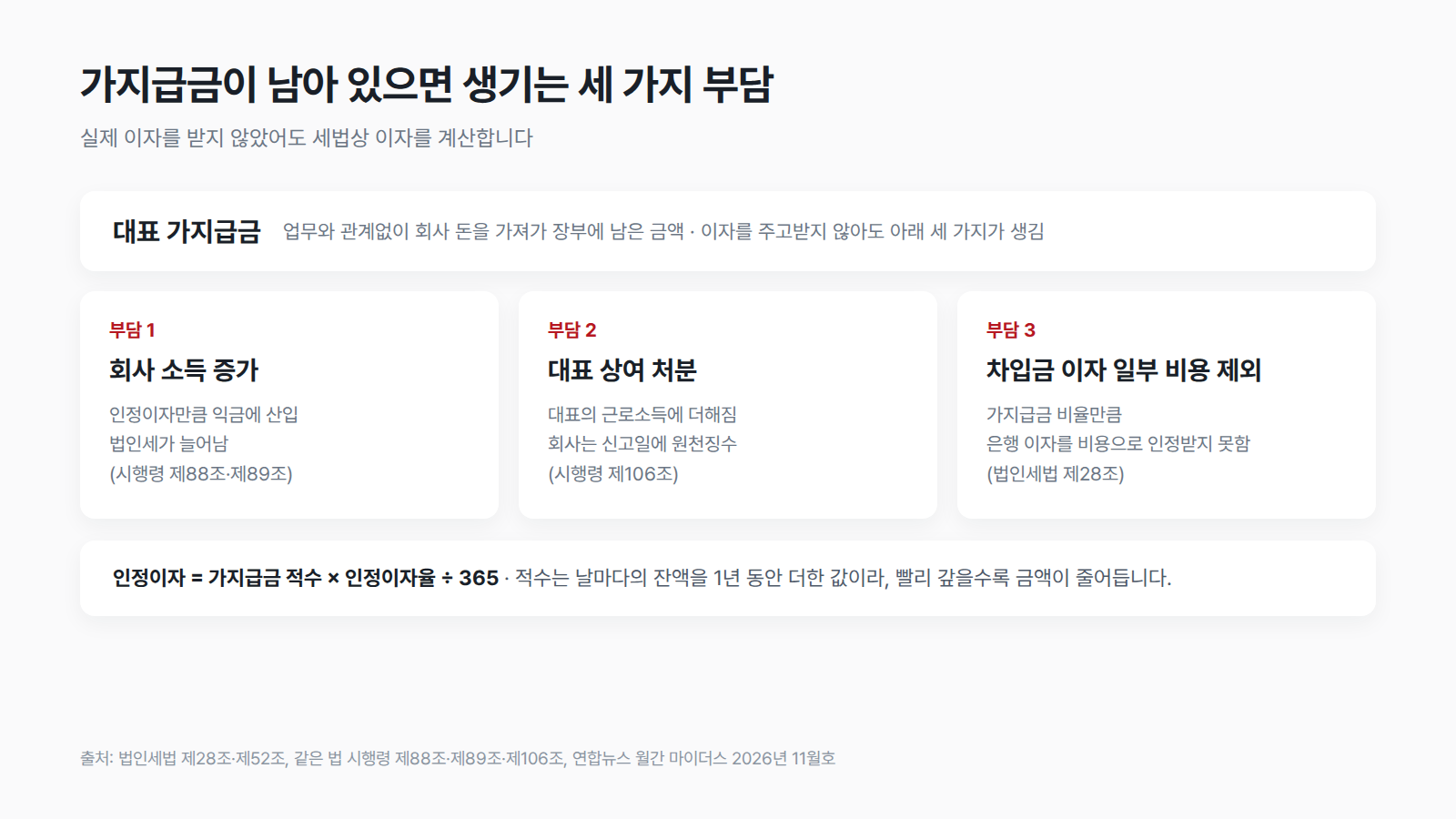
Under the Corporate Tax Act, lending money to a related party such as an executive without charging interest, or at a low rate, is treated as an unfair transaction. So the difference between the interest calculated at the tax-law market rate and the interest actually received is added to the company's income. This is deemed interest (Articles 88 and 89 of the Enforcement Decree of the Corporate Tax Act).
- Higher company income — The deemed interest is included in gross income (company revenue for tax purposes), so corporate tax goes up.
- Treated as a bonus to the CEO — The money is regarded as having gone to the CEO and is added to the CEO's earned income, and the company must withhold income tax as if it had paid a bonus on the corporate tax filing date (Article 106 of the Enforcement Decree).
- Part of loan interest disallowed — If the company has bank borrowings, the interest corresponding to the non-business director loan is not recognized as an expense (Article 28 of the Corporate Tax Act).
The formula is simple: deemed interest = cumulative director loan balance × deemed interest rate ÷ 365. The cumulative balance is the sum of each day's balance over the year, so KRW 100 million outstanding for the whole year equals KRW 100 million × 365 days. Even if you repay just before closing, the deemed interest for the period already accumulated remains; it only stops accumulating after repayment. The sooner you repay, the smaller the amount.
4.6% versus your company's borrowing rate
The deemed interest rate is one of two. The default is the weighted average borrowing rate: multiply the balance and interest rate of each loan the company has from non-related lenders such as banks, add them up and divide by the total balance. In the following cases, the overdraft rate of 4.6% a year applies instead (Article 89(3) of the Enforcement Decree and Article 43(2) of the Enforcement Rules).
- Companies with no borrowings — Without outside borrowings from banks or others, no weighted average can be calculated, so 4.6% is used.
- Loans older than five years — For a loan where five years have passed since it was made (or since the renewal date, if renewed), 4.6% applies to that loan only.
- When the company elects it — If the company elects 4.6% when filing its corporate tax return, it applies for that fiscal year and the following two fiscal years.
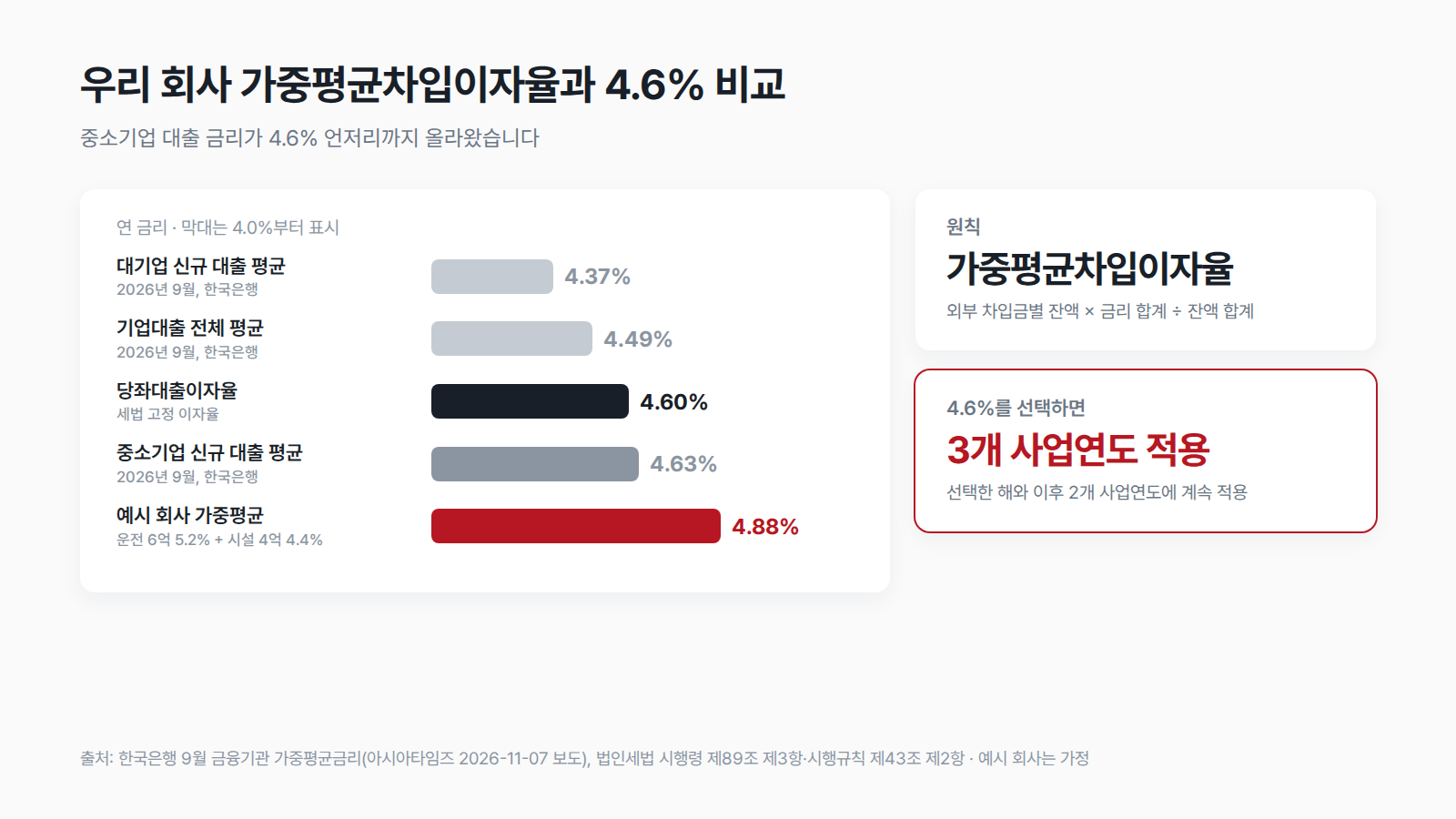
This is where the effect of rising rates shows. A few years ago, when company loan rates were in the 3% range, the weighted average borrowing rate was lower than 4.6%, so following the default usually produced smaller deemed interest. But now that the average rate on new SME loans reached 4.63% in September, a company's weighted average may be above 4.6% or below it. You cannot tell which is more favorable until you gather the balances and rates of all your company's loans and do the calculation yourself.
You should also keep in mind that the election is locked in for three years. If you elect 4.6%, the same rate applies next year and the year after regardless of how loan rates move. With rate hikes widely expected, that may work in your favor now, but if rates fall again it may become less favorable than the default. The safe approach is to decide together with your tax accountant, looking at three years of borrowing plans.
Your company's burden in numbers
Let us work through an example. A CEO director loan of KRW 200 million is outstanding for the whole year, and no interest has been received. The company's bank borrowings total KRW 1 billion: KRW 600 million in working capital loans (5.2% a year) and KRW 400 million in facility loans (4.4% a year).
- Weighted average borrowing rate — (KRW 600 million × 5.2% + KRW 400 million × 4.4%) ÷ KRW 1 billion = KRW 48.8 million ÷ KRW 1 billion = 4.88% a year
- Deemed interest under the default — KRW 200 million × 4.88% = KRW 9.76 million
- If 4.6% is elected — KRW 200 million × 4.6% = KRW 9.2 million, KRW 560,000 less than under the default.
- Loan interest disallowed — Annual interest of KRW 48.8 million × (KRW 200 million director loan ÷ KRW 1 billion borrowings) = KRW 9.76 million is excluded from expenses.
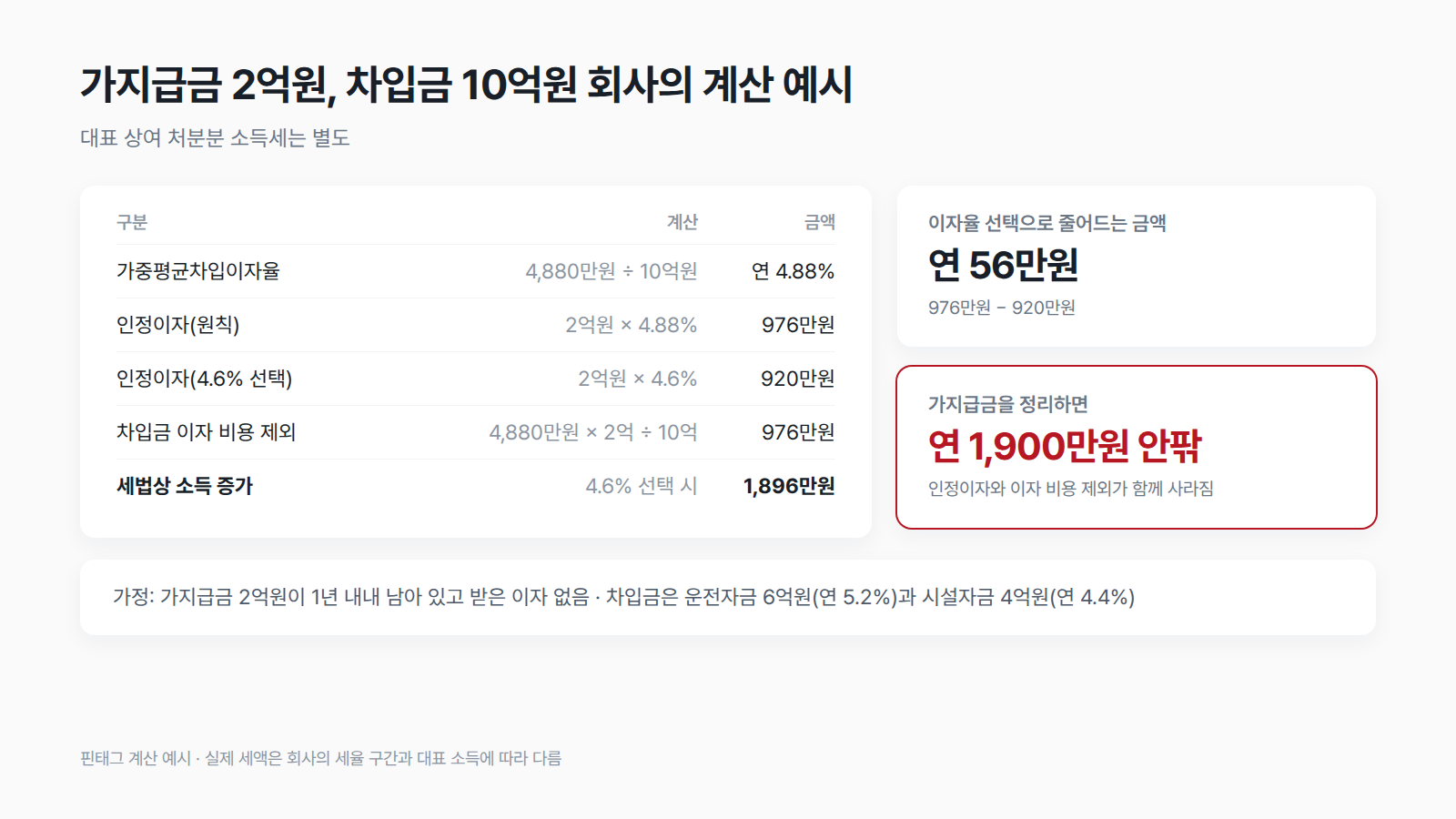
In sum, this company's taxable income rises by KRW 18.96 million a year (if 4.6% is elected) to KRW 19.52 million (under the default) because of the KRW 200 million director loan. On top of that, income tax applies separately to the KRW 9.2 million to KRW 9.76 million treated as a bonus to the CEO. The rate election can save KRW 560,000, but reducing the director loan itself removes roughly KRW 19 million every year. That is why clearing the principal comes before choosing a rate.
What changes depending on how you clear it
There are several ways to reduce a director loan, and each one changes the type of tax the CEO pays. In practice, companies often combine two or three rather than relying on one.
| Method | Effect on the company | Burden on the CEO | What to check |
|---|---|---|---|
| Repay with personal funds | Balance falls immediately | No additional tax | Source of repayment |
| Salary or bonus | Recognized as an expense | Progressive earned income tax | Pay criteria in articles or shareholder resolution |
| Dividend | No expense effect | Comprehensive taxation above KRW 20 million a year | Basis for interim dividends in the articles |
| Pay the deemed interest in | Avoids bonus treatment | Interest only | The payment is company revenue |
There are points to watch as well. Executive bonuses are recognized as expenses only within pay criteria set by the articles of incorporation or a resolution of the shareholders' meeting or board, so raising pay retroactively at year-end can lead to disputes with the tax authorities. Dividends are usually resolved at the regular shareholders' meeting the following year, so paying one within the year requires a basis for interim dividends in the articles (Article 462-3 of the Commercial Act). Treating KRW 300 million as a bonus in a single year can push the CEO into a high tax bracket when combined with other income, so a plan that clears it over several years is needed.

What to do before December 31
- Confirm the director loan balance and dates — Organize each transaction by when, how much and why the money went out. If there were withdrawals and repayments during the year, you need daily balances to calculate the cumulative balance.
- List your borrowings — Put the loan balances and rates from every bank in one table and calculate the weighted average borrowing rate. If your loans are spread across several banks, this step takes the longest.
- Compare with 4.6% — Check whether your company's weighted average is above or below 4.6%, and discuss with your tax accountant whether to elect it, taking borrowing plans from next year onward into account.
- Decide the method and amount — Based on the size of profits and the CEO's income level, decide how to mix repayment, bonus and dividend, and check the pay and interim dividend clauses in your articles.
- Check the timing of funds for clearing it — In December, cash for salaries, bonuses and VAT overlaps. Work out in advance how much repayment or bonus payments will reduce the company's balance, through the January VAT payment date.
A director loan is not a problem solved by hiding it or wiping it out all at once. The standard for managing it is being able to explain how it arose and how it will be cleared, and the starting point is seeing your company's loans and balances as accurate numbers.
📌 Start your deemed interest rate comparison by bringing all your company's loan rates onto one screen. Once you register a digital certificate or financial institution accounts, Fintag automatically updates loan balances and rates and account balances across multiple banks on a regular schedule, shows them on one screen and a calendar, and lets you check your upcoming balance flow with cash flow forecasts. Get started right away on the free plan. → app.fintag.kr
Thank you. From the Fintag team.